

Article contents

Spread betting allows you to avoid tax on your trades as your winnings are counted as gambling, rather than investment profit, which is tax-free. Spread betting is hugely popular, and is essentially betting an asset like a stock would increase or decrease in value instead of physically buying and selling the share itself.
Ever heard of spread betting? In the UK, it’s a pretty popular option for trading things like stocks and shares and currencies. One reason is that’s it’s free of capital gains tax.
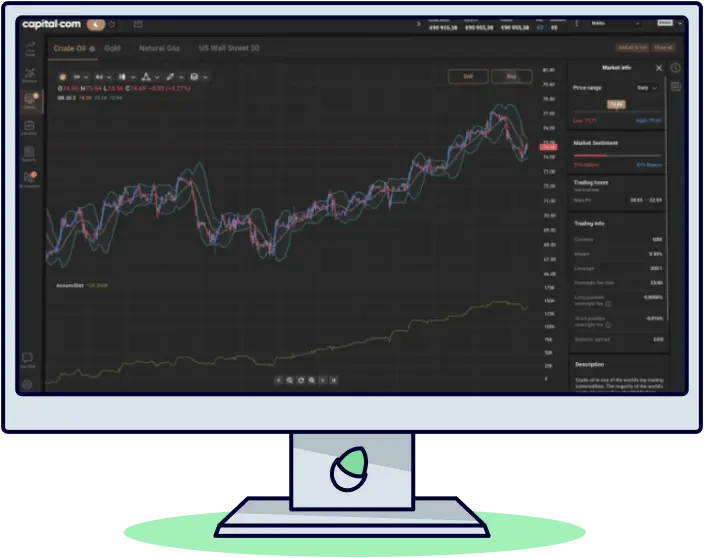
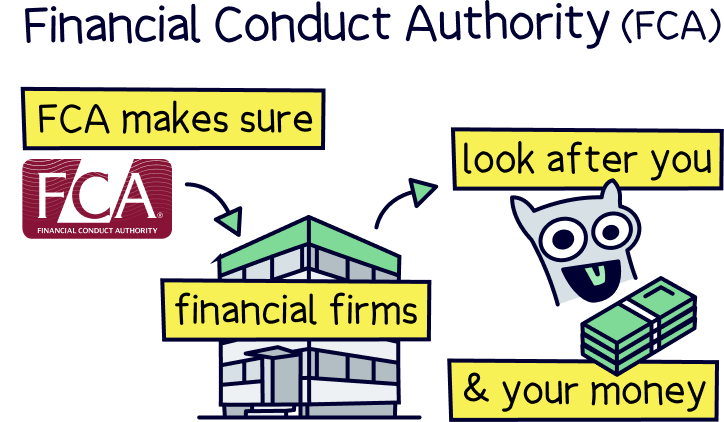
In the UK, spread betting is a form of trading on the price movements of financial markets, rather than owning the underlying asset. It is legal and regulated by the Financial Conduct Authority (FCA) when offered by authorised providers.
For UK tax purposes, profits from spread betting are currently not subject to capital gains tax or stamp duty, as spread betting is generally treated as gambling rather than investing. However, tax treatment depends on individual circumstances and may change, so this information should not be considered tax advice.
Unlike a traditional fixed-odds sports bet (for example, odds of 10/1), spread betting does not have a predefined return. Instead, you choose a stake per point of movement in the underlying market (for example, £5 per point), and your profit or loss depends on how far the market moves, not just the direction.
Capital.com is a leader in trading. There’s a wide range of investments and low fees overall.
Suppose a share price is quoted at 100p, and the market moves in 1-point (1p) increments. You decide to stake £5 per point.
If the price rises from 100p to 105p (a 5-point move), your gross profit would be £25 (£5 × 5 points).
If the price falls from 100p to 95p (a 5-point move in the opposite direction), your gross loss would be £25.
This example is illustrative only and does not include costs such as spreads, overnight financing charges, or other fees, which can increase losses as well as reduce profits. Losses can exceed your initial stake, and spread betting is not suitable for everyone.
Spread betting involves the use of leverage, which means you can take a position that is larger than the amount you deposit. While leverage can increase potential gains, it also increases potential losses, and losses can occur very quickly.
Leverage works by requiring you to place an initial deposit (margin), which represents only a portion of the full position size. The broker allows you to gain exposure to a larger market position based on this deposit.
Now suppose you deposit £50 and use 5x leverage, giving you exposure to a position size of £250.
If the underlying price moves 10% in your favour, the profit would be calculated on the full £250 exposure, not just your £50 deposit.
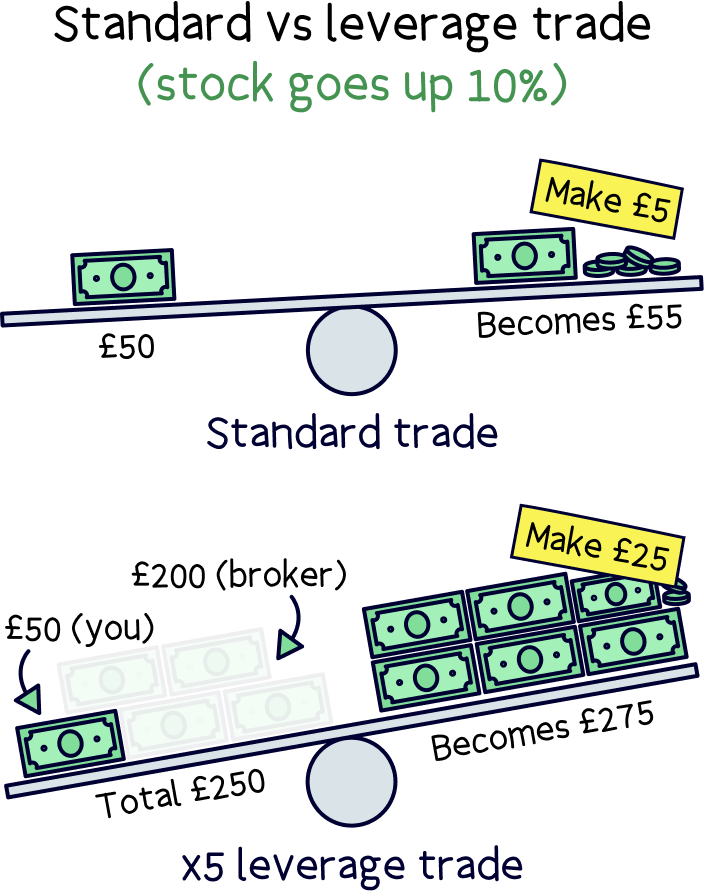
If the price moves 10% against you, the loss would also be calculated on the full £250 exposure, resulting in a £25 loss, which represents half of your original deposit.
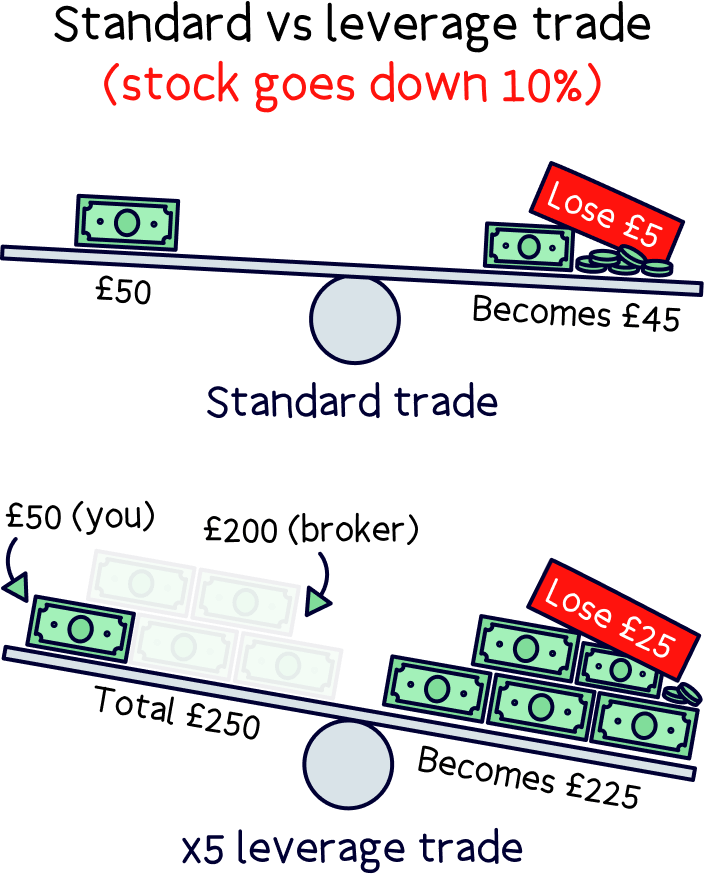
This example is illustrative only. It does not include costs such as spreads or overnight financing, which can further increase losses. You can lose money rapidly when trading with leverage, and spread betting is not suitable for everyone.
Capital.com is a leader in trading. There’s a wide range of investments and low fees overall.
Spread betting also allows you to take positions on falling prices, often referred to as short selling. This means you can speculate on a market moving down, rather than up, by staking an amount per point of price decrease.
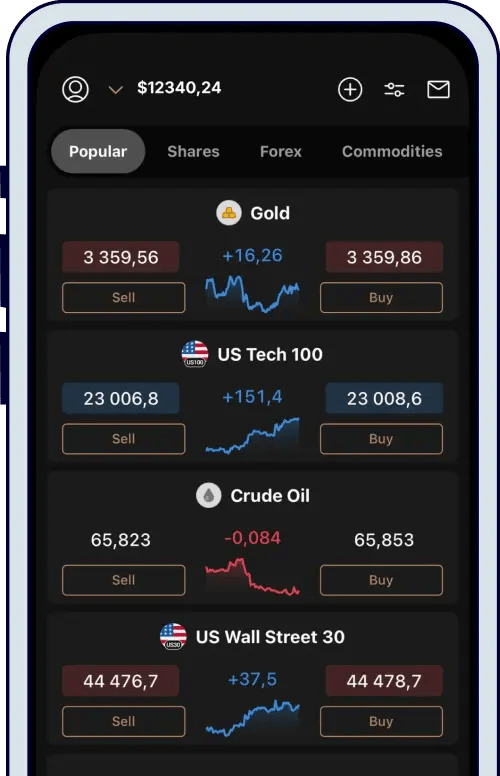
Short positions are calculated in the same way as long positions, with profits and losses depending on how far the market moves against or in favour of your position. Short selling carries the same risks as other leveraged trades, including the risk of rapid losses.
While short selling can be used as part of broader trading or risk-management approaches, it is more complex and requires a clear understanding of how leveraged products work. It should not be assumed to reduce risk, and it is not appropriate for all traders.
Here’s our top investment platform for spread betting.
Capital.com is a leader in trading. There’s a wide range of investments and low fees overall.




Capital.com is a very well established, and award-winning trading platform, best in class in five categories at the 2026 BrokerChooser Awards.
It’s suited more towards experienced and advanced traders due to its features, but if you’re a beginner, it’s still a great place to learn, as there’s a wide range of trading resources and a user-friendly interface.
The number of markets you can trade is huge, including thousands of stocks across the globe, and offers forex (over 120 currency pairs, which you can trade 24/5). And it offers spread betting, so you can trade tax-free (in the UK). Tax treatment depends on individual circumstances.
The fees are fair overall. There’s no commission, although other fees apply, and it’s free to open an account and deposit money. You’ll pay a fee based on the spread of an asset, which is the difference between the buy price of an asset and the sell price. This is typical with most platforms, and with Capital.com the spread is transparent.
It’s very popular, with over 750,000 active traders globally, and the customer service is excellent, and runs 24/7.
Overall it’s a great platform, and well worth checking out.
With spread betting you can trade:
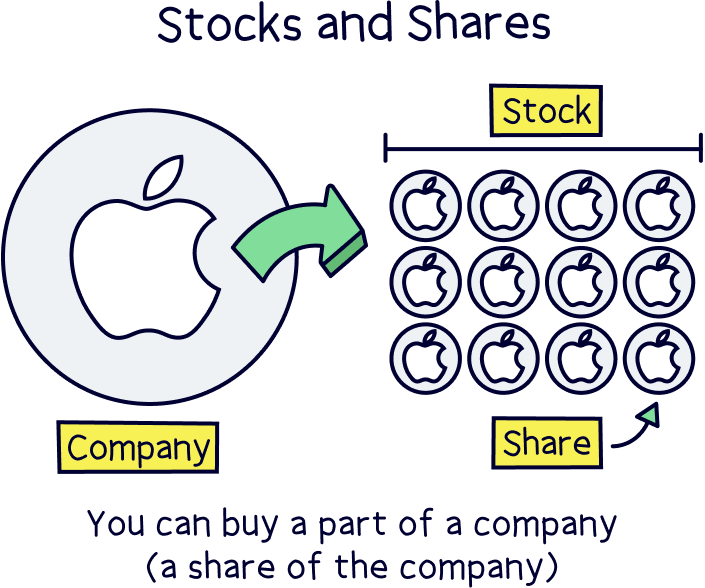
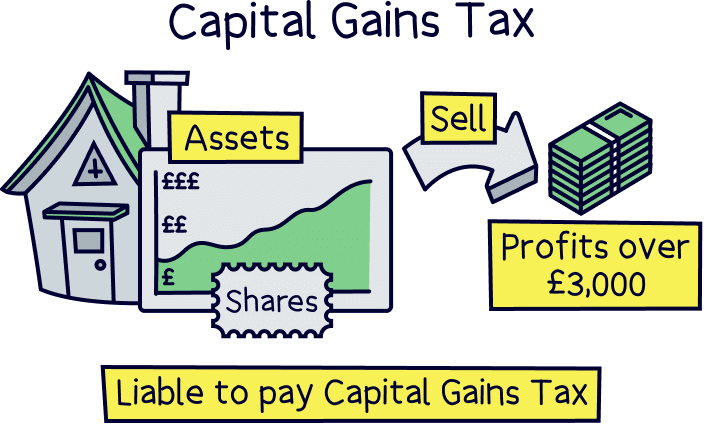
With investing, you typically pay Capital Gains Tax when an asset you purchase rises in value and you then sell it, booking a profit. You’d pay the tax on the profit you make.
There are other types of taxes, such as Income Tax (tax on income) and Dividend Tax (tax on dividends, which are profits made by companies paid out to its owners, called shareholders), but for the typical investor, the primary tax is Capital Gains Tax.
The amount you’ll actually pay in Capital Gains Tax depends on your annual income (e.g. your salary), and you’d pay 18% if you are a basic rate taxpayer (earning less than £50,270 per year) and 24% if you are a higher rate or additional rate taxpayer (earning more than £50,270 per year).
You also have a Capital Gain Tax allowance each tax year (April 6th to April 5th the following year), which is £3,000. So, the first £3,000 profit you make is shielded from tax, and you don’t need to report it to HMRC if you are under this. You will need to file a Self Assessment tax return if you go over, as you need to pay the tax.
Capital.com is a leader in trading. There’s a wide range of investments and low fees overall.
There we have it. Spread betting can be a suitable option to trade tax-free (if you’re in the UK). Spread betting is very similar to typical trading and investing, but with a bit of a twist, instead of buying an asset (like a share) directly and then selling it later, you would open a spread bet with the broker (investment platform), and wager an amount for each point increase the asset rises (or falls) instead. It sounds a bit complicated, but it’s simple once you’re familiar with it.
Imagine a share price of 100p, and you wager £5 per point increase. If and when the share price rises, you would make £5 per point increase. If it rises to 105p, you would make 5x £5, which is £25.
Did we mention that it's completely tax-free? You avoid any and all taxes on the trade. With a typical investment, you might pay Capital Gains Tax on your profits. Tax rules will depend on your own financial situation however.
And with spread betting, you can trade with borrowed money (leverage) to increase your bet size to potentially win more money (with higher risk), and you can trade both price directions, so you can bet a share would fall in value too, opening up a wide range of investment opportunities.
You can put a spread bet on pretty much any asset, with the popular ones being stocks and shares, stock indices (e.g. FTSE100), currencies (hugely popular) and commodities (things like gold and silver).
To get started, we recommend checking out Capital.com, our recommended broker.
We’d love to hear from you, and it will help others too.
Edward Savage is a leading expert on money, with a background of 8 years working in financial services in London, has a business, accounting and finance degree, runs an investing community, and teaches people about money. He writes about all aspects of personal finance, including pensions, investing, mortgages and insurance.

This article was written, reviewed and fact checked by the expert team at Nuts About Money. You’re in safe hands. Learn more.
We're experts in all things investing, with many years of combined experience writing and talking about investing and trading. Some of our team were top financial advisors. We understand and love helping people learn more about both short term trading and investing for the long term – investing can be a great way to grow your money over time.

More than 20 years of combined experience researching and writing about investing
Qualified team (APFS - Advanced Diploma in Financial Planning)
A wide range of trading and investing companies researched and reviewed, and a transparent review process
We follow a strict editorial code to ensure you get the best information possible
Capital.com is a leader in trading. There’s a wide range of investments and low fees overall.